
Introduction and interview by Giovanni Agnoloni

Prof. Steven White (from msmary.edu)
Steven White, a Professor of Contemporary History and International Studies at Mount St. Mary’s University (Maryland, USA), is a scholar of modern Italian history and politics. While a junior high school student, he moved to Pavia, in the north of Italy, with his family. As a result he was able to learn Italian and to become acquainted with our culture. He deepened this exposure through his undergraduate and post-graduate studies.
Professor White’s interests have focused on the figures of Alcide De Gasperi and Antonio Gramsci, as well as the broader evolution of Italian politics and Italo-American relations since World War II. In addition to his work on modern Italy, he has studied Russian and Spanish language and history. He has served as a consultant with the Foreign Service Institute of the American State Department, where he has taught Italian and Iberian Area Studies to American diplomats appointed for posts in the Old Continent. Today – at the beginning of a new season in American history – he is telling us something more about his work and the “impressions of Italy” coming from the United States.
—
– The remote roots of your interest in Italy and its historical and political reality date back to your first visit to Pavia, when you were thirteen. Was it a ‘love at first glance’ or a passion that would grow with time, through your studies and your academic experience?
It was both. From the beginning of my middle school years I was touched by the hospitality shown to me as a young teenager and also to my family. I loved the compact, walkable cityscape of Pavia and the other cities we visited. And what better place to begin to learn Latin than a land bestrewn with inscription-bearing ruins? As a student for two years in the scuola media [Junior High School], I was captivated by the subject of Lettere – combining History, Geography, Italian and Latin – because of its synthetic, humanistic spirit (even though the word humanism had not yet entered my vocabulary). As presented by my wonderful professore, Guglielmo Balbi, each materia [subject] within Lettere flowed beautifully into the others.
Other dimensions of Italian life and culture cast their spell on me during return visits as a graduate student and then as a teacher. I am enamored of the culture section of newspapers like “La Repubblica” and the “Corriere della Sera”. These newspapers have an energy and intimacy of discourse which we just don’t have in this country – an animated dibattito [debate] from day to day and week to week between authors, artists, philosophers, other intellectuals and public figures. This conversation is like a boisterous family’s conversation writ large.
As a result of my teaching about Italy both at Mount Saint Mary’s and at the State Department, I have become intrigued by the way in which Italy has come to combine elements of pre-modern, modern and post-modern values and practices. I’m thinking for instance of the whole ethos of food and eating, which is defended so stoutly by the Slow Food movement, even as Italy is in the forefront of the food packaging and shipping industry. Also the persistence of strong family ties even as Italy evolves from a gemeinschaft to a geschellschaft society.
– Throughout your career as a researcher and an expert on Italian history, you have been dealing with the evolution of the Italian political and social scenery, starting from the Second World War. Which have been the key points of your analyses?
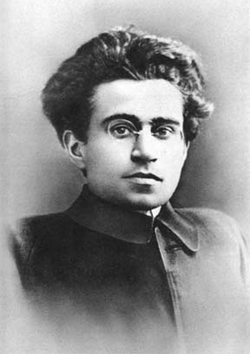
Antonio Gramsci (from Wikipedia)
Having grown up in an ideologically non-reflective, consensual society, I have been fascinated by the sophistication and self-confidence of Italy’s Marxist, lay/progressive and Catholic subcultures. In the course of my studies post-1943 Italian history, I have come to grips closely with each of these subcultures. I explored first Italian Marxism in a master’s thesis devoted to the thought of Antonio Gramsci in its initial contact with the Russian Revolution. In my M.A. thesis I argued that Gramsci appears to have formed some of his first impressions of the Bolshevik Revolution via the American Max Eastman’s radical newspaper “The Liberator”.
My doctoral research on the defascistization of Italian schooling brought me in close contact with the pedagogical theories and careers of such radical laici/progressisti as Sicilian Gino Ferretti and Florentine Ernesto Codignola, and also the liberal intellectuals Adolfo Omodeo and Guido De Ruggiero, each of whom served as Ministers of Public Instruction in 1944. Impressed by the Church’s successful blunting of either lay/progressive or Marxist influence in the post-war reconstruction of Italian schooling, I have turned my attention over the last decade and a half to the history of Christian Democracy and of the Church. Most recently, I have completed an article which stresses the category of Pius XII’s romanità (understood as both an ideological commitment and a mode of personal behavior) as a key leitmotif of his papacy.
– Your work has largely focused on the history of the Christian Democracy and the figure of Alcide De Gasperi, and also with the relations between Italy and the United States after the end of World War II. What, in particular, has drawn your attention to the evolution of this political party, and what, specifically, to the Christian Democratic statesman?
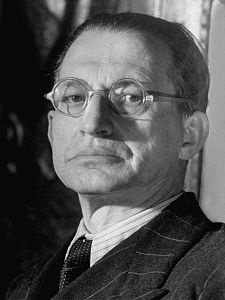 As I have said, my work on Christian Democracy grew out of my dissertation. I couldn’t help being struck by the fragility of Deweyan Anglo-American orchestrated educational reforms (and the frequent turnover in the Ministry of Public Instruction as contrasted with the stability of educational policy once Christian Democrat Guido Gonella assumed the education portfolio). Clearly, I needed to learn more about this powerful but (to me) obscure political movement. I have been shocked at how little name recognition even De Gasperi (in the picture on the right, from Wikipedia) had (not to mention lesser party lights) among otherwise well-informed colleagues at my university. Only one biography in English has been published – Elisa Carillo’s 1965 study Alcide De Gasperi: The Long Apprenticeship, and it traces the statesman’s career only up to 1943. My biography will carry De Gasperi through the balance of his career.
Until quite recently, Italian biographers of the Christian Democratic leader have been very partisan—either hostile or hagiographic. This situation is finally changing: over half a century after his death, De Gasperi’s personal papers are now being transferred from family custody to the archives of the European University Institute in Florence. This development should shed light on a key contradiction inherent in De Gasperi’s legacy: how are we to square the regressive, sometimes repressive and often corrupt nature of his party, Christian Democracy, with De Gasperi’s personal rectitude, disinterestedness and capacity for charity even with political rivals?
– An important part of your studies has also concerned the thought of Antonio Gramsci. What is your vision and, in general, what is the prevalent opinion in America, as to the contraposition between the Christian Democracy and the Communist Party, in Italy, after the end of World War II.?
For many American students of my generation, Antonio Gramsci’s theories seemed to embody such a fertile “third way” between liberal, uninhibited capitalism and Stalinist communism. How could one resist the subtle and ambiguous promise evoked by the word “hegemony”? There was a sense on the left that, sooner or later, one needed to take Gramsci’s measure as an ineluctable part of one’s intellectual maturation.
Beyond the ivory tower Gramsci’s name and ideas were unknown- and if they had been known, they would have been dismissed out of hand. The ongoing hostility of successive American administrations towards all forms of communism is well known. Even the Italian state’s “opening to the left” toward the socialists was resisted until well into the 1960s. The American government had little understanding of modern Italian political Catholicism. As the Christian Democrats faltered in the early 1950s, intense debates broke out within American policymaking circles as to whether De Gasperi was “losing his touch.” The Communists’ continuing strength, on the other hand, was attributed to the party’s sinister propaganda and not difficult socio-economic conditions (e.g. miseria, indigence).
From graduate school onward, I have remained fascinated by the modalities of coexistence which developed during the secondo dopoguerra [the years after the end of WWII] between Italian Catholics and Communists, despite the fierce polarization produced by the Cold War. Bologna has a special place in my heart. The late Robert Evans, one of my mentors at the University of Virginia, wrote a pathbreaking study of the “Red city”, “Coexistence: Communism and Its Practice in Bologna” (1967). In addition, my son Dan spent a memorable year there as a Dickinson College undergraduate.
– You have also collaborated with the American State Department. Which are the main elements of the vision of Italian (and, more in general, European) political history, that then was (and today is) present in this institution? What is the perception that America nowadays has of the European political reality, and more specifically of the Italian one?

Mario Monti (from Wikipedia)
Monti was also well received when he came to Washington recently, even if the American media largely passed over the event. My friend and fellow historian Mario Del Pero has written perceptively about this. President Obama clearly appreciates the calming effect Monti’s appointment has had on the Italian bond market, and the Italian economy in general. A trans-Atlantic recession originating in Mediterranean Europe still represents a major threat to Obama’s hopes for re-election. Italy continues to be regarded as one of the United States’ most receptive (if second tier) European partners.
It is difficult to generalize about the State Department’s approach to Italy over the whole parabola of post-World War II history. Since the end of the cold War and especially since 9/11, there has been a shift of concern and ressources toward the Middle East, Eastern Europe, Eurasia and East Asia. The figure of Berlusconi captured the imaginations of the American media and public, in the process reinforcing many of our most unfortunate stereotypes about Italians – that they are flashy but dupllicitous, utterly incapapble of separating the public good from personal advantage and gratification. After such a soap opera Monti seems, well, dull.
Ironically, the European Union was finally registering with Americans as a formidable international presence (as both rival and partner) when the euro crisus broke. At present many Americans have reverted to a skeptical view of the EU, disapproving of Germany on the one hand as well as Greece, Portugal, Spain and Italy on the other.
– “The election of Barack Obama as the new American President has determined some relevant changes in the American society, although not everyone is satisfied by his choices. What is the current state of the work in his political action? And how do you think the relationship between the USA and Europe, on the one hand, and the USA and China, Russia and the Middle-East, on the other, will respectively evolve?”
Contrary to many Americans’ expectations, Obama’s strongest suit as president has been foreign rather than domestic policy. Hillary Clinto shares the credit for seeking to repair our dialogue with the European Union, calm relations with Russia, further restrain the nuclear arms race, withdraw from Iraq and lay the groundwork for a similar withdrawal from Afghanistan. I am mystified at the American Right’s success in demonizing what they term “Obamacare,” as if it were some kind of Orwellian Big Brother threat to “individual freedom”. We need a way to strengthen our social welfare net. By the same token I fervently hope you can find ways to streamline but also shore up your saftey net, which is far better than ours!
– Please, tell us something about your latest works, as well as about their prospects of publication in Italy.
My ongoing research on Alcide De Gasperi has brought me to Italy many times. In December of 2004 I had the pleasure of delivering a series of lectures in Rome, Naples and Trento on the subject of De Gasperi’s image in American public opinion and the American media between 1943 and 1954. I am currently on the international scientific committee of the Florentine online journal “Historied” (www.historied.net), devoted to the history of education.
My wife Alica and I have undertaken a joint project, compiling an annotated bibliography of Italian and English language articles and books on De Gasperi published since 1979, inclusive not only of a name but also of a subject index—a feature not included in most Italian scholarly works.
– Do you think that the end of Berlusconi’s “age” and the opening of a new Italian scenario, currently characterized by a “technical” government substantially controlled by bankers and scholars, may create the opportunity for a reflection on the significance of such a statesman as Alcide De Gasperi? And how can a biography focused on him impact such a relevant and unpredictable historical phase?
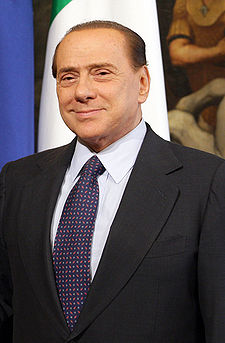 Yes I do believe that the transition form Berlusconi’s regime to the current “technical” government offers an important opportunity to reflect on Alcide De Gasperi’s role in the first post-war decade. De Gasperi’s honesty, personal modesty, and capacity for political mediation and compromise all stand in stark contrast to Berlusconi’s self-aggrandizing, opportunistic political style (see Silvio Berlusconi in the picture on the right, from Wikipedia). At the same time, De Gasperi was an unapologetic politician, ready to do business with other politicians like Saragat, Nenni and Togliatti. He was also a principled believer in parliamentarism. These qualities set him apart from the current Monti government–even though his deference to Einaudi on economic matters does have some contemporary echoes.
Some half century after his death in 1954, De Gasperi’s role as founder and leader of the DC is no longer salient. The secularization of Italian society, and the Christian Democrats’ long, stagnant and ultimately corrupt tenure in power, have all contributed to this loss. On the other hand now, as much as at any time in the history of the Italian republic, De Gasperi represents an impressive and inspirational man of state. He was also a deeply patriotic man in a sincere but unostentatious way, but also one of the four or five key founding fathers of the Common Market. Crucial to his influence in the latter respect were the personal friendships he nurtured with other European federalists such as Schumann and Adenauer. This is still very instructive. Regardless of one’s views of his austerity measures, Monti is valuable to Italy right now for the cachet he offers in other European capitals.

