
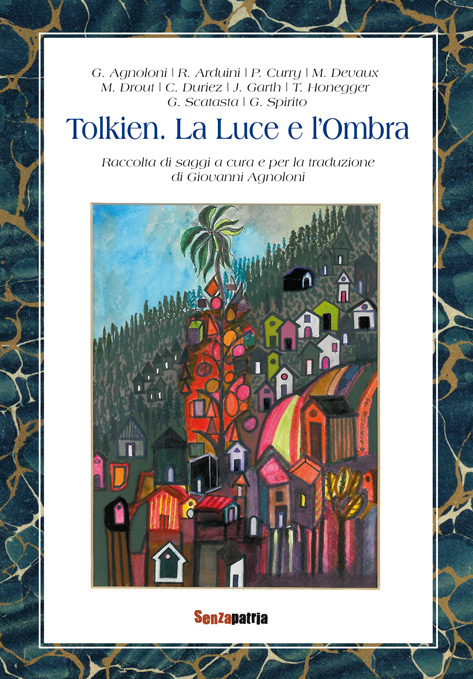
 This essay on Tolkien‘s literature, by Fr. Guglielmo Spirito, OFM Conv, who is a Professor at the Theological Institute of Assisi, reproduces his speech at the Oxford Tolkien Conference, which took place in August 2006. Its Italian translation, by Giovanni Agnoloni, appears in the collection of essays Tolkien. La Luce e l’Ombra (in the picture on the left), edited by Agnoloni, published by Senzapatria Editore in 2011.
Fr. Guglielmo Spirito (in the picture below, in the right) is also one of the most relevant scholars in the field of Tolkien studies. This essay reflects his exquisitely philosophic and spiritual approach to the Legendarium of the Professor of Oxford.
—
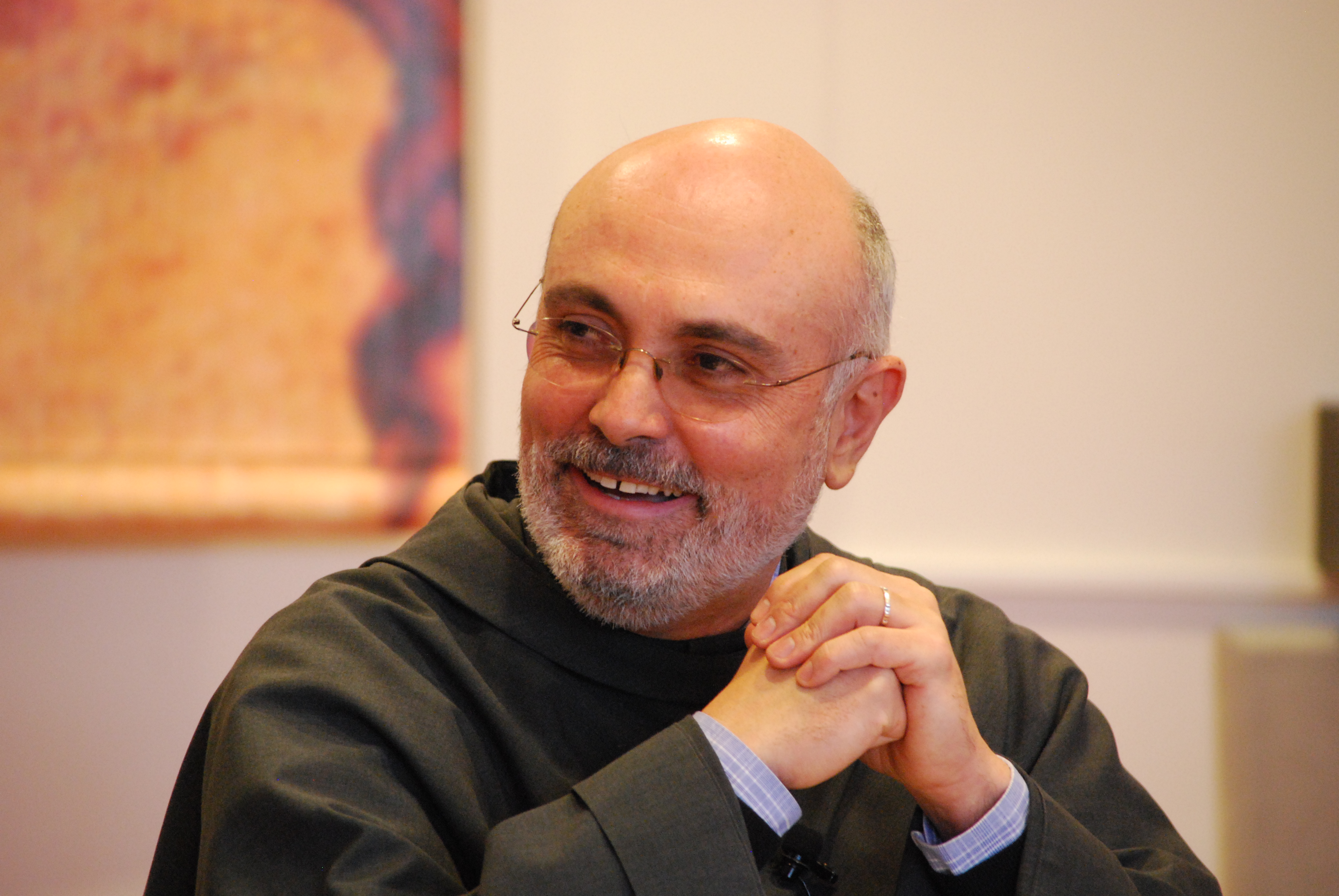
Fr. Guglielmo Spirito, OFM Conv
Theological Institute of Assisi
The Oxford Tolkien Conference (Monday 21st to Friday 25th August 2006)
The Light of Holiness: the Healing Power of Tolkien’s Narrative
The Lord of the Rings: Sources of Inspiration
(© Guglielmo Spirito, 2006)
In the life of any individual, a book that is reread several times is one that both establishes itself as an intimate and familiar conversational partner, but which at every reading also conceals and reveals different things, opens different doors (1) Such a book helps us to cross borders, to enter into a new and transfigured world. And that is exactly what we experience as we read Tolkien’s Books. He possesses to an unusual degree the gift of creative imagination. So, as Chesterton used to say
“that though I could not with a crayon get the best out of the landscape, it does not follow that the landscape was not getting the best out of me” (2)
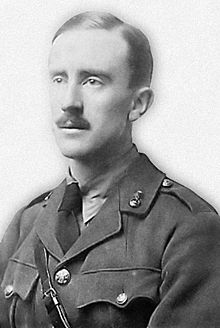
Tolkien in a 1916 picture (from Wikipedia)
I will try to use only two texts from Tolkien, the first a letter to Miss Batten-Phelps written in Autumn 1971.
He answered her saying: “You speak of ‘a sanity and sanctity’ in the L.R. ‘which is a power in itself’. I was deeply moved. Nothing of the kind had been said to me before. But by a strange chance, just as I was beginning this letter, I had one from a man, who classified himself as ‘an unbeliever, or at best a man of belated ly and dimly dawning religious feeling … but you’, he said, ‘create a world in which some sort of faith seems to be everywhere without a visible source, like light from an invisible lamp’. I can only answer: ‘Of his own sanity no man can securely judge. If sanctity inhabits his work or as a pervading light illumines it then it does not come from him but through him. And neither of you would perceive it in these terms unless it was with you also. Otherwise you would see and feel nothing, or (if some other spirit was present) you would be filled with contempt, nausea, hatred. “Leaves out of the elf-country, gah!” “Lembas – dust and ashes, we don’t eat that.” (3)
Tolkien is a misunderstood man precisely because he is a mythunderstood man. He understood the nature and meaning of myth in a manner which has not been grasped by most of his critics, though some of them, perhaps most of them, share the conviction that was Lewis’ “as he expressed it to Tolkien, myths were’lies and therefore worthless, even though breathed through silver.’ ‘No,’ Tolkien replied. ‘They are not lies’.” (4)
What is the applicability of this understanding to our lives today? What is the underlying reality or truth that Tolkien would have us see? (5)
The second text from Tolkien comes from The Two Towers in The window on the West:
Then came the voice of Faramir close behind. ‘Let them see!’ he said. The scarves were removed and their hoods drawn back, and they blinked and gasped. They stood on a wet floor of polished stone, the doorstep, as it were, of a rough-hewn gate of rock opening dark behind them. But in front a thin veil of water was hung, so near that Frodo could have put an outstretched arm into it. It faced westward. The level shafts of the setting sun behind beat upon it, and the red light was broken into many flickering beams of ever-changing colour. It was as if they stood at the window of some elven-tower, curtained with threaded jewels of silver and gold, and ruby, sapphire and amethyst, all kindled with an unconsuming fire. ‘At least by good chance we came at the right hour to reward you for your patience.’ Said Faramir. ‘This is the Window of the Sunset. Henneth Annun, fairest of all the falls of Ithilien, land of many fountains. Few strangers have ever seen it. But there is no kingly hall behind to match it. Enter now and see!’ Even as he spoke the sun sank, and the fire faded in the flowing water. (6)
So if we will reject the reality of this “it leads to sadness or to wrath” said Tolkien (7). This passage and those surrounding it are the key texts for interpreting the heart of Tolkien’s work. He was an artist who created a secondary world that has “the inner consistency of reality” for most, though not all of his readers. But he was also a Christian, and his Christianity gave him the joy and vision that find expression in his work. (8)
Sadness immobilizes us internally, because in the place of light it puts the deepest darkness. In the time of sadness we take no account of anything, neither of God, nor of our neighbour, nor even of ourselves – we experience the purest form of darkness. Darkness renders everything indistinguishable, while light enables us to distinguish and discriminate, and within its truth the human person makes progress. (9) Sadness reverses darkness inward and wrath outward.
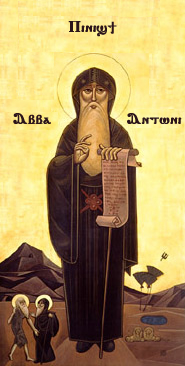
St Anthony the Great, one of the Desert Fathers (from Wikipedia)
The Desert Fathers, who were experts in human soul, know that anger awakens within us the most uncompassionate feelings, that it destroys any disposition we may have to become more refined and provokes the drunkenness of darkness, which extinguishes reason and makes every feeling blind. Anger is expressed from a position of strength, but it is born in weakness. We become angry because something hinders us and surpasses us, threatens to surround us with insecurity. The soul’s serenity and tranquility witness to a firm faith and security, a spiritual state independent of human feelings of power or weakness. (10)
The consolation of fairy-stories, the joy of the happy ending: or more correctly, of the good catastrophe, the sudden joyous ‘turn’ (for there is no true end to any fairy-tale): this joy which is one of the things which fairy-stories can produce supremely well, is not essentially ‘escapist’ or ‘fugitive’. In its fairy-tale – or otherworld – setting, it is a sudden and miraculous grace, never to be counted on to recur. It does not deny the existence of dyscatastrophe, of sorrow and failure: the possibility of these is necessary to the joy of deliverance: it denies (in the face of much evidence, if you will), universal final defeat, and in so far is evangelium, giving a fleeting glimpse of Joy, Joy beyond the walls of the world, poignant as grief. (11)
Tolkien chooses the term “eucatastrophe” to emphasize that the sudden “turning” or unexpected deliverance at the end of a true tale of Faerie must be experienced not as an achievement of triumphant revenge, but rather as a divine gift. The joy produced by such a happy ending requires a surprise, a deliverance that no human effort could have made possible. In a letter to his son, Christopher, Tolkien uses the example of a boy dying of tubercular peritonitis who was taken to the Grotto at Lourdes, but not cured. However, on the train ride home, as he passed within sight of the Grotto again, he was healed. Tolkien writes that this story, “with its apparent sad ending and then its sudden unhoped-for happy ending” gave him that peculiar emotion which comes from eucatastrophe, because it is a “sudden glimpse of the truth …” (12) “a ray of light through the very chinks of the universe about us.” One of the principle mythological forms to represent holiness and sanctity is Light, taken not as a symbol but as an embodiment, of holiness. (13)
Presence has a depth that lives behind the form or below the surface. There is a well of presence within every thing, but it is usually hidden from the human eye. This comes in different ripples to the surface. No human can ever see anything fully. All we see are aspects of things. Being human is like being in a room of almost total darkness. The walls are deep and impenetrable, but there are crevices which let in the outside light. Each time you look out, all you see is a single angle or aspect of something. From within this continual dark, you are unable to control or direct the things outside this room. You are utterly dependent on them to offer you different views of themselves. All you ever see are dimensions. This is why it is so difficult to be certain of anything. As the New Testament says, “Now we see in a glass darkly, then we shall see face to face. ” (14)
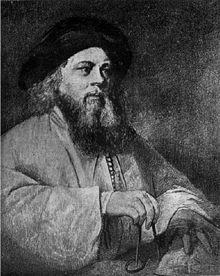
In English the phrase that a person “has presence” is hard to define. There are people whose being here and now is felt, even though they do not display themselves in action or speech. They have “presence.” There are other people who may be here all the time, and no one will be aware of their presence. Of a person whose outwardness communicates something of his indwelling power or greatness, whose soul is radiant and conveys itself without words. We say he has presence. The whole earth is full of His glory. The outwardness of the world communicates something of the indwelling greatness of God, which is radiant and conveys itself without words. “there is no speech, there are no words, neither is their voice heard.” And yet, “their radiance goes out through all the earth and their words to the end of the world” (Psalm 19:4-5). The glory is neither an esthetic nor a physical category. It is sensed in grandeur, but it is more than grandeur. It is, as we said, a living presence or the effulgence of a living presence. Standing face to face with the world, we often sense a spirit which surpasses our ability to comprehend. The world is too much for us. It is crammed with marvel. The glory is not an exception but an aura that lies about all being, a spiritual setting of reality. The perception of the glory is a rare occurrence in our lives. We fail to wonder, we fail to respond to the presence. This is the tragedy of every man; “to dim all wonder by indifference.” Life is routine and routine is resistance to the wonder. “Replete is the world with a spiritual radiance, replete with sublime and marvellous secrets. But a small hand held against the eye hides it all,” said the Baal Shem (in the picture on the right, below – from Wikipedia). “Just as a small coin held over the face can block out the sight of a mountain, so can the vanities of living block out the sight of the infinite light.’ ‘Of what avail is an open eye, if the heart is blind?” (15)
Awe is the awareness of transcendent meaning, of a spiritual suggestiveness of reality, an allusiveness to transcendent meaning. The world in its grandeur is full of a spiritual radiance, for which we have neither name nor concept.
Awe, then is more than a feeling. It is an answer of the heart and mind to the presence of mystery in all things, an intuition for a meaning that is beyond the mystery, an awareness of the transcendent worth of the universe.
The imperative of awe is its certificate of evidence, a universal certificate which we all seal with tremor and fascination, not because we desire to, but because we are stunned and cannot brave it. There is so much more meaning in reality than the soul can take in. To our sense of mystery and wonder the world is too incredible, too meaningful for us, and its existence the most unlikely, the most unbelievable fact, contrary to all reasonable expectations. Even our ability to wonder fills us with amazement. This, then is an insight we gain in acts of wonder; not to measure meaning in terms of our own mind, but to sense a meaning infinitely greater than ourselves.” (16)
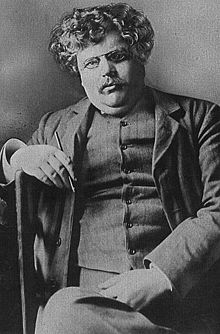
G.K. Chesterton (from Wikipedia)
Chesterton used to say that ”Fairyland is nothing but the sunny country of common sense. It is not Earth that judges Heaven, but Heaven that judges Earth.” (17)
’The best lack all conviction’. George Steiner wrote a book called Real Presences. Is There Anything in What We Say? And the title says it all. Steiner maintains that the profound crisis which we are living has its roots in the last century, and the collapse of shared belief that our words have anything to do with how things are. They disclose nothing. The covenant between word and world is broken. It is this break of the covenant between word and world which constitutes one of the few genuine revolutions of spirit in western history and which defines modernity itself.’ (18)
So, If the sun doesn’t shine, they –Frodo, Sam and Faramir- would have not seen anything… The glittering drops are not the source of their own light!
The Window on The West “invites us to surrender the safe security of the disengaged reader, to lose our mastery, to give up being ‘little mortal absolutes’, to entrust ourselves to the flow and thrust of a story beyond our control, like the one who, we believe, gave himself into other people’s hands so that we might live.” (19)
Up to now, we have been speaking of light, and of beauty. Light is the life-blood of the world, of all things the most desirable, for it is the “luminous form of the beautiful” It carries within itself the music of meaning. But the source of both light and beauty, according to Tolkien, is fire. (20)
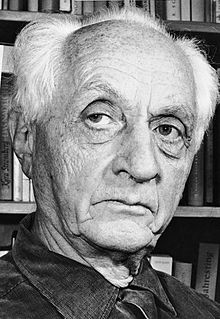
Károly Kerényi (in the picture on the right – from Wikipedia) defined the stuff of mythology as:
an immemorial and traditional body of material contained in tales about gods and god-like beings, heroic battles and journeys to the Underworld – mythologem is the best Greek word for them – tales already well-known but not unamenable to further reshaping. Myth is the movement of this material … In a true mythologem this meaning is not something that could be expressed just as well and just as fully in a non-mythological way.
Furthermore, he writes, ‘Myth gives a ground, lays a foundation. It does not answer the question “why?” but “whence?” and thus, where to from here? A fantasy like The Lord of the Rings can help us not only to imagine wonder, but realise it by returning to our world and seeing it afresh. It offers renewal not through escapism, but reconnection.21
There is no tale ever told, Tolkien says of the gospel, “that men would rather find was true, and none which so many sceptical men have accepted as true on its own merits. … To reject it leads either to sadness or to wrath” (22). The phrasing is curiously cautious; “would rather” is in the subjunctive, not the indicative or declarative mood. It is a story that has been “accepted as true,” which suggests what men want rather than what men know. This is not to suggest that Tolkien did not believe the story was true. Nothing in his life is clearer than his commitment to his faith.
Perhaps the key lies in the underlying, light-associated nature of directional movement. It can be seen most clearly at those points of intersection where westward-moving, light-seeking men cross the path of eastward-moving, light-declining Elves. But Gandalf said to himself about Frodo
He is not half through yet, and to what he will become in the end not even Elrond can foretell. Not to evil, I think. He may become like a glass filled with a clear light for eyes to see that can… (23)
Gandalf’s auxiliary verb is significant. He does not say Frodo will become, or must become, but that he may become. This is speculation, not prediction. May, Anglo-Saxon magma, “to be able,” describes capacity, not actuality. What Gandalf sees in Frodo is potential; it may or may not be realized. (24)

Ian McKellen as Gandalf in the LOTR movie (from Wikipedia)
But that potential of Frodo’s is our own: ‘Things that are covered up from men in this world will become transparent as globes of crystal. (25)
The fact that The Lord of the Rings is indirectly responsible for (or at least involved in) nearly everything of value in my present life, fades to unimportance beside that best magic – the ability to make reality itself more real. (26)
The doctrine of Creation teaches us to see the world as created, which is to say as given. Our eyes are opened to the pure gratuitousness of being. Nothing need exist. Everything is a gift. To ask God for what I desire and to thank God when I receive it is living in the real world. It is opening our eyes to the pure gratuity of being. The word ‘thank’ derives from ‘think’ (27).
Thanking is thinking truly and prayer helps us to think well, So if I am to describe a human being truthfully, Timothy Radclilffe said it is not enough for me to just describe what is before my eyes. I am reaching out for what cannot be fully told now, what can only be glimpsed at the edge of language. Seamus Heaney describes a poem by Dylan Thomas as giving ‘the sensation of language on the move towards a destination in knowledge’ He writes,
We go to poetry, we go to literature in general, to be forwarded within ourselves. The best it can do is to give us an experience that is like foreknowledge of certain things which we already seem to be remembering. (28)
“To be human is to belong. Belonging is a circle that embraces everything; if we reject it, we damage our nature. The word “belonging” holds together the two fundamental aspects of life: Being and Longing, the longings of our Being and the being of our Longing.” (29)
We know, no more, where the Window on the West lies, but the sun still glitters and shines, the sun is, there is a source of light. As through Frodo, and some eyes that were able to glimpse on the shining light of the falling sun, and that was great, so there is a light which has, through us, a sanity and sanctity which refreshes us, however, it doesn’t come from us but through us! (30)
In the words of Pope John Paul II:
The light of the East has illumined the universal Church, from the moment when “a rising sun” appeared above us (Lk 1:78): Jesus Christ, our Lord, whom all Christians invoke as the Redeemer of man and the hope of the world
On the threshold of the third millennium we all hear the cry of those oppressed by the burden of grave threats, but who, perhaps even without realizing it, long to know what God in his love intended. These people feel that a ray of light, if it is welcomed, is capable of dispelling the shadows which cover the horizon of the Father’s tenderness.
Mary, “Mother of the star that never sets,” “dawn of the mystical day,” “rising of the sun of glory,” shows us the Orientale Lumen.Every day in the East the sun of hope rises again, the light that restores life to the human race. It is from the East, according to a lovely image, that our Saviour will come again (cf. Mt 24:27). (31)
There is a story from the Fathers of the Egyptian Desert:
“Abba Isaiah called one of the brethren, washed his feet, put a handful of lentils into the pot and brought them to him as soon as they had boiled. The brother said to him, ‘They are not cooked, Abba.’ The old man replied, ‘Is it not enough simply to have seen the fire? That alone is a great consolation.’” (32)
Also for us! Having glimpsed the splintering light which come from the radiance of the Living Sun, Who is and ever shall be, that could be enough for us…for a while at least!
Until we meet the Shining Sun face to face in the Everlasting West…
—
Footnotes:
(1) Cfr. Williams, Rowan,, Why study the past? The Quest for Historical Church, London, Darton Longman Todd, 2005, p.94.
(2) Chesterton, G.K., Essential Writings, Maryknoll New York, Orbis Books, 2003, p. 81.
(3) Tolkien, John Ronald Reuel, The Letters of J.R.R. Tolkien, London, Unwin Hyman Ltd., 1981, letter n.328 to Carole Batten-Phelps Autumn 1971.
(4) Cfr. Carpenter, Humphrey, Tolkien: A Biography, Boston, Houghton Mifflin, 1977, p. 147 in West, John G. Jr., Celebrating Middle-Earth The Lord of the Rings as a Defense of Western Civilization, Seattle, Inklings Books, 1999, p. 87. tolkien, John Ronald Reuel, Tre and leaf, Great Britain, Grafton, 1992, p.50-51: “To many, Fantasy, this sub-creative art which plays strange tricks with the world and all that is in it, combining nouns and redistributing adjectives, has seemed suspect, if not illegitimate. To some it has seemed at least a childish folly, a thing only for peoples or for persons in their youth. As for its legitimacy I will say no more than to quote a brief passage from a letter I once wrote to a man who described myth and fairy-story as ‘lies’; though to do him justice he was kind enough and confused enough to call fairy-story making ‘Breathing a lie through Silver’.”
Dear Sir,’ I said – `Although now long estranged,
Man is not wholly lost nor wholly changed.
Dis-graced he may be, yet is not de-throned,
and keeps the rags of lordship once he owned:
Man, Sub-creator, the refracted Light
through whom is splintered from a single White
to many hues, and endlessly combined
in living shapes that move from mind to mind.
Though all the crannies of the world we filled
with Elves and Goblins, though we dared to build
Gods and their houses out of dark and light,
and sowed the seed of dragons -’twas our right
(used or misused). That right has not decayed:
we make still by the law in which we’re made.’
Cfr. Fernandez, Irène, C.S. Lewis – Mythe, raison ardente, Genève Francia, Ad Solem Editions, 2005, p. 72.
(5) Cfr. Dickerson, Matthew T., Following Gandalf Epic Battles and Moral Victory in the Lord of the Rings, Michigan, Brazos Press, 2003, p. 232.
(6) Tolkien, John Ronald Reuel, The Lord of the Rings, London, George Allen & Unwin Ltd, 1966, p. 700.
(7) Tolkien, Tree and leaf, p.65.
(8) Cfr. Purtill, Richard L., J. R. R. Tolkien Myth, Morality, and Religion, San Francisco, Ignatius Press, 2003, p.188-189 .“Not all of those who dislike and reject Tolkien’s work do so in an Orcish spirit. No doubt some of Tolkien’s critics hate God, and others merely hate Elves”.
(9) Cfr. Ramfos, Stelios , Like a Pelican in the Wilderness Reflections on the Sayings of the Desert Fathers, Brookline Massachusetts, Holy Cross Orthodox Press, 2000, p.159. About the symbol of Darkness: cfr. devaux, Michael, Tolkien, les racines du légendaire, Genève, Ad Solem, 2003, p. 191-245 (Michael Devaux, “Les anges de l’Ombre chez Tolkien: chair, corps et corruption”).
(10) Cfr. Ibidem, p. 160
(11) Davenport, John J., Happy Endings and Religious Hope, p. 68 in bassham, The Lord of the Rings on Book to Rule Them All, Gregory and Bronson, Eric, Chicago, Open Court, 2003, p. 210.
(12) Cfr. Pearce, Joseph, Tolkien, l’uomo e il mito, Marietti, 2010 Tolkien: Man and Myth, Harper Collins, p. 107, Richard Jeffery, interview with the author. Cfr.tolkien, Tre and leaf, p. 62.
(13) Cfr. irigaray, Ricardo, Elfos, Hobbits y Dragones una investigacion sobre la simbologia de Tolkien, Buenos Aires, Tierra Media, 1999, p.210. Cfr. tolkien, The Lord of the Rings p.570:’Mithrandir!’ he cried. ‘Mithrandir!’ ‘Well met, I say to you again, Legolas!’ said the old man. They all gazed at him. His hair was white as snow in the sunshine; and gleaming white was his robe; the eyes under his deep brows were bright, piercing as the rays of sun; power was in his hand. Between wonder, joy, and fear they stood and found no words to say. At last Aragorn stirred. ‘Gandalf!’ he said. ‘Beyond all hope you return to us in our need! What veil was over my sight? Gandalf!’ Gimli said nothing, but sank to his knees, shading his eyes. ‘Gandalf,’ the old man repeated, as if recalling from old memory a long disused word. ‘Yes, that was the name. I was Gandalf.’ He stepped down from the rock, and picking up his grey cloak wrapped it about him: it seemed as if the sun had been shining, but now was hid in cloud again.”
(14) O’Donohue, John, Eternal Echoes Celtic Reflections on Our Yearning to Belong, New York, HarperCollins, 2002, p.54, 204.
(15) Cfr. Heschel, Abraham Joshua, God In Search of Man A Philosophy of Judaism, New York, The Noonday Press, 1991, p. 82, 83, 85. Cfr. fernandez, I, C.S. Lewis – Mythe, raison ardente: Imagination et Réalité Selon C. S. Lewis (Geneva: Ad Solem, 2005 FORMTEXT ), p. 67: D’autant plus que la réalité que 1’on approche est, selon la terminologie bien connue de R. Otto dans un livre qui a beaucoup compté pour Lewis, « numineuse », et donc à la fois fascinante et redoutable, tremendum. Lewis y reconnaît son expérience, et pourrait dire avec saint Augustin: et inhorresco et inardesco.. On éprouve en sa présence ce que les Anglais appellent awe. Malgré 1’usure des mots, il ne faut pas oublier que ce terme désigne une expérience qui peut étre trop forte pour étre la bienvenue; le poids du sacré, à 1’état brut, si on peut dire, sans médiation, peut étre trop lourd, comme c’est le cas pour la reine de Drum: «Et ce monde se dérobait / Et sa chair se dérobait, / Et elle était toute petite […].»
(16) Cfr. Heschel, Abraham Joshua, God In Search of Man A Philosophy of Judaism, p.106, 107.
See Williams, Rowan, The Dwelling of The Light Praying with Icons of Christ, Norwich, The Canterbury Press, 2003, p.4, 5, 8, 9, 10, 58: So the disciples look at Jesus, and see him as coming out from an immeasurable depth; behind or within him, infinity opens up, ‘the dwelling of the light’, to borrow the haunting phrase from Job 38,19. The often-noted fact that icons show the lines of perspective reversed, so that they converge on your eye, not on a vanishing point in the distance within the picture is a way of telling us that, once again, what is true of Jesus lies at the heart of all this style of painting; we are being taught to look through into the deep wells of life and truth. In the Gospels, the transfiguration story is introduced with the apparently innocent words, ‘after six days’ (in Matthew and Mark), or ‘after about eight days’ (in Luke). From early times, commentators have said that this is an allusion to the days of creation: the transfiguration is the climax of the creative work of God. Christ’s light alone will make the final pattern coherent, for each one of us as for all human history. And that light shines on the far side of the world’s limits, the dawn of the eighth day. When Jesus is transfigured, it is as if there is a brief glimpse of the end of all things – the world aflame with God’s light. and this gives a “degree of hope not with a nice and easy message of consolation but with the knowledge that there is a depth to the world’s reality and out of that comes the light which will somehow connect, … all the complex, painful, shapeless experience of human beings. St. Augustine once wrote of the Kingdom of Heaven as ‘not just to be looked at but to be lived in’, and expounded this living in the Kingdom in terms of Journeying with Christ: it is the same point here. Accepting the invitation, going through the gate into the new Territory …
See Chryssavgis, John, Light Through Darkness The Orthodox Tradition, London, Darton Longman Todd, 2004, p. 110, 111: The icon reminds us that there is no double vision, no double order in creation. It speaks in this world the language of the age to come. The icon converts the beholder from a restricted, limited point of view to a fuller, spiritual vision, where we see everything as reconciled and as united in a single reality, ‘in him through whom all things live, move, and have their being’ (Acts 17, 28). For the light of the icon is the light of reconciliation, the light of restoration, the light of the resurrection. It is not the waning light of this world; it ‘knows no evening’, to quote an Orthodox hymn.” “The icon presupposes, indeed proposes, another light in which to see things, a ‘different way of life’, as the Orthodox Easter liturgy proclaims. This is a vision that liberates us from every alien vision. It provides for us another means of communication, beyond the conceptual, beyond the written, beyond the spoken word. This is the language of silence and of mystery, the language of the kingdom to come.
(17) Chesterton, Essential Writings, p.131.
(18) Radcliffe, Timothy op., Sing a New Song The Christian Vocation, Dublin, Dominican Publications, 1999, p.234, 235.
(19) Radcliffe, Timothy op., I Call You Friends, London & New York, Continuum, 2001, p.212.
(20) Balthasar, Hans Urs von, The Glory of the Lord, Ignatius Press, 1982, p.441 in Caldecott, Stratford, The Power of the Ring The Spiritual Vision Behind the Lord of the Rings, New York, The Crossroad Publishing Company, 2005, p.103 – 107: “ create ex nihilo(“from nothing”). For Tolkien the fire represents life, love and creativity, the wisdom and love of God that burns at the heart of the world and sustains it in existence – it is a willed emanation from the creative energy of God’s own self; it is the life of God shared with the world.”
The Book of Wisdom describes something that appears very similar to Tolkien’s “secret fire”. Wisdom or Sophia is said to precede the creation of the world and to be placed at its very heart: “For she is a breath of the power of God, and a pure emanation of the glory of the Almighty; therefore nothing defiled gain entrance into her. For she is a reflection of eternal light; a spotless mirror of the working of God, and an image of his goodness” (Wisd 7: 25-26) …
Moses encounters God in the burning bush when he is told to lead the people out of Egypt. Later, after talking with God on the mountain, the face of Moses shines so brightly that it has to be veiled. He tells the people: “The Lord your God is a consuming fire..” (Deut 4:24). God dwells in “light inaccessible,” yet in the New Testament that light emanates from and rests upon a living man. Peter, James and John see their master clothed in this light and transfigured by it on Mount Tabor. “I am the light of the world,” he tells the man born blind (John 9: 5). It is the Incarnation which takes away the veil.
All love, all hope, all music finds a home with God, “who with divine freedom, but also with divine consistency, has fashioned for himself in his creation a body through which to reveal his glory” Here in this body is the secret fire of our making and of our remaking, the luminous center of a new universe.”
(21) Cfr. Kerényi, Károly, ‘Prolegomena’, in C. G. Jung and K. Kerényi, Introduction to a Science of Mythology: The Myth of the Divine Child and the Mysteries of Eleusis, London, Routledge & Kegan Paul, 1951, p. 2,3-4,8 in curry, Patrick, Defending Middle-Earth Tolkien: Myth and Modernity, Boston New York, Hoghton Mifflin Company, 2004, p.118,147.
(22) Tolkien, Tre and leaf, p. 65.
(23) Tolkien, The Lord of the Rings, p. 239.
(24) Cfr. Flieger, Verlyn, Splintered Light Logos and Language in Tolkien’s World, London, The Kent State University Press, 2002, p. 30, 124, 156, 157. john paul ii, apostolic letter, The Light of the east Orientale lumen, Boston, Paoline Book & Media, 02/ 05/1995, p.32: This process of becoming ever more moderate and sparing, more transparent to himself, can cause him to fall into pride and intransigence if he comes to believe that these are the fruits of his own ascetic efforts.
(25) Heschel, Abraham Joshua, The Sabbath Its Meaning for modern man, Boston, Shambhala, 2003, p.34. See ramfos, Like a Pelican in the Wilderness Reflections on the Sayings of the Desert Fathers, p. 248: We shall close our exploration with an earthly holy trinity: Abba Pambo, Abba Sisoes and Abba Silvanus. For of all the holy ascetics in the collection these alone are singled out for having the light of God shining in their faces: “They said of Abba Pambo that just as Moses received the image of the glory of Adam when his face was made radiant, so too the face of Abba Pambo shone like lightning and he was like a king seated ori his throne. The same was true of Abba Silvanus and Abba Sisoes”. Of Abba Sisoes they said “that when he was about to die, with the fathers sitting near him, his face shone like the sun.
See Wood, Ralph C., The Gospel According to Tolkien Vision of the Kingdom in Middle-earth, Louisville London, Westminster John Knox Press, 2003, p. 142-143: When Aragon arose all that beheld him gazed in silence. For it seemed to them that he was revealed to them now for the first time. Tall as the sea-kings of old, he stood above all that were near; ancient of days he seemed and yet in the flower of manhood; and wisdom sat upon his brow, and strength and healing were in his hands, and a light was about him. And then Faramir cried: ‘Behold the King!’” Argon’s parting words to Arwen are poignant indeed: “In sorrow we must go, but not in despair. Behold! we are not bound for ever to the circles of the world, and beyond them is more than memory. Farewell!” “What this ‘beyond’ might mean is already implicit in the death of Aragon. His corpse is virtually beatified, as if his body were imbued with the same glory and sanctity that were disclosed at his coronation: “Then a great beauty was revealed in him, so that all who came after there looked on him in wonder; for they saw that the grace of his youth, and the valour of his manhood, and the wisdom and majesty of his age were blended together. And long there he lay, an image of the splendour of the Kings of Men in glory undimmed before the breaking of the world”.
(26) Cfr. Duane, Diane, Meditations on Middle-Earth, New York, St. Martin’s Press, 2001, p.129.
(27) Ayto, John, Bloomsbury Dictionary of Word Origins, Bloomsbury, London, 1990, p.526 in radcliffe, Timothy op., What is the Point of Being a Christian?, London New York, Burns & Oates, 2006, p. 127.
(28) Radcliffe, Timothy op., What is the Point of Being a Christian?, Burns & Oates, 2006, p. 127-128.
(29) O’Donohue, Eternal Echoes Celtic Reflections on Our Yearning to Belong, p.2. See p. 229-230: There is a great story about the loss of belonging in Gershom Scholem’s book Major Trends in Jewish Mysticism. In the eighteenth century, there arose in Eastern Europe a remarkable mystical movement called Hassidism. Its founder was known as the Baal Shem Tov, and he was a religious genius and pioneer. One day, a calamity threatened the community in which he lived, and so he called his chief disciple and said, ‘Come, let us go out into the woods.’ And they went to a certain very special spot that the master seemed to know about, and he built a very special kind of fire, and then he offered a special prayer. He said, ‘Oh, God, They people are in dire need. Please help us in this moment of distress, etc.’ Then to his disciple, he said, ‘It is all right now. Everything will be all right.’ They went back and found that, indeed, the calamity that had been impending somehow had been averted. The master died, and in the next generation, this disciple became the leader of the same group. And in his day, likewise, another major disaster threatened to wipe out the community. Now, he took his chief disciple and they set out for the woods, but he had forgotten just where the exact place was, though he did remember how to light the fire. So he said, ‘Oh, God, I don’t know where the place is, but you are everywhere, so let me light the fire here. Your people need you, calamity threatens. Please, help.’ And then after the prayer he turned to his disciple and said, ‘It is all right now.’ And when they returned to the town, they were greeted with the joyful news that the threat had been removed. Well, then, that disciple became the master in the next generation, and once again , a catastrophe was imminent. This time he went out with his disciple. He no longer knew the place, and he had forgotten how to make the fire, but he still knew the prayer and he said, ‘God, I don’t know this place very well, but you are everywhere. I don’t know how to make the fire, but all the elements are in your hands. Your people need you. We ask your help’. Then he turned to his disciple and said, ‘Now it is all right. We may go back.’ They went back and everything indeed was all right. The story concludes by stating that today, we don’t know the place; we no longer know how to make the fire; we don’t even know how to pray. So all we can do is to tell the story, and to hope that somehow, the telling of the story itself will help us in this hour of need.”
(30) Cfr. Fernandez, C.S. Lewis – Mythe, raison ardente, p. 62, 66: Il ne fait que «briller» (SbJ, ch. xi) un instant à travers tel livre, telle musique, tel souvenir, mais
il n’étaít pas en eux, il ne venait qu’à travers eux […] Tout cela […] n’est pas la chose méme; ce n’est que 1’odeur d’une fleur que nous n’avons pas trouvée,l’écho d’une mélodie que nous n”avons pas entendue, des nouvelles d’un pays que nous n’avons jamais vísité… («The Weight of Glory »).
On “se trouve confronté à une «objectivité absolue», «un fait èternel», source de toute «factualité»: «Eternal Fact, the Father of all facthood» (GD, p.42), «the thing that simply and entirely is, the fountain of all facthood» (M, 11). See ramfos, Like a Pelican in the Wilderness Reflections on the Sayings of the Desert Fathers, p.253-254: Therefore the illumination of the faces of the three elders was a “work” which interpreted the anguish of transparency, the dispelling of psychological impenetrability. They struggled to attain purity, that is, the passage of light and the elimination of density. Theirstruggle called for endurance and the acceptance of exhaustion. For the aim of the hesychast’s struggle is to receive the Kingdom, not to attain a personal sanctification. If we take the two terms to be synonymous, the distinction has no meaning. But if we attribute to sanctification a merely sacred character, then the distinction between receiving the Kingdom and receiving sanctification becomes a significant one, because on the one hand it shows the spiritual truth of interior unity to be a source of light, and on the other it mingles the light of our interior unity with our personal identity.
(31) John Paul II, apostolic letter, The Light of the east Orientale lumen, p. 11, 54-55.
(32) The Sayings of the Desert Fathers, Kalamazoo, Cistercian Publications, 1984, p.70.


outstanding, impressive and so interesting…
Thank you so much, Farid!