
by Leonardo Masi
(translation by Sara Matteoli)
Ten years after George Harrison’s death, a documentary on the guitarist, directed by Martin Scorsese, has recently been released. So far, we do not know if it will be distributed in Italy as well. Actually, the movie, entitled Living in the material world, has not impressed the critics, who have in fact noticed that its basic mistake is the choice of an uninteresting subject. But perhaps the charm of Harrison, the Quiet Beatle, is precisely that of not wanting to look attractive, with his constant desire to run away from the “role” of a rock-star. Dhani Harrison, George’s son, born in 1978 (eight years after the Beatles broke up) says that until the age of seven he was convinced that his father was a gardener, because he always saw him dirty with mud and busy with planting trees. Only when one day at school his mates chased him singing Yellow Submarine, and he asked his father for an explanation, he replied: “Ah, yes, I was part of the Beatles. Sorry, I forgot to tell you.”
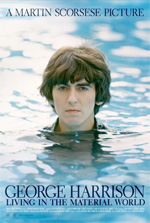
Living in the Material World (from MyMovies)
From this long (three hours and half) documentary by Scorsese, that I have seen in Warsaw, there comes out that Harrison was a much less calm man than we would expect, with a character full of facets and interests. Beside the gorgeous songs written for the Beatles, such as While my guitar gently weeps, Within you without you, Something or Here comes the sun, Harrison influenced very much the sound of the others’ songs – McCartney admits that his And I love her would not have been the way it is without Harrison’s theme, made of four notes note played with a classic guitar, which opens the song. A guitarist with personal style (few but incisive notes), Harrison introduced into both The Beatles’ music and lyrics an “Indian” element: a true key to the records of the quartet from 1965 onwards (from the use of the sitar in the song Norwegian Wood). In terms of image, the musician seems to have inaugurated the figure – which will then become almost archetypal – of the quiet rock-star, the balanced element in rock bands with two leaders (or with one leader and one frontman). Still, while many claim (or not) the superiority of John Lennon on Paul McCartney, or that of Roger Waters on David Gilmour, they seem to forget how George Harrison for The Beatles or Richard Wright for the Pink Floyd represented the “connective tissue” (from Scorsese’s documentary I got the impression that the magic balance that held together the Fab Four broke right when the guitarist grew sick of “tipping the scale” and started to believe more and more in his creative talent).
The third men were very important for many bands, such as The Who and the Led Zeppelin, where, while the couples Roger Daltrey-Pete Townshend and Robert Plant-Jimmy Page made a fuss on the stage, John Entwistle and John Paul Jones created their own virtuosities. But what an energy in Entwistle’s melodic lines (real solos), which picture him as a sort of “Jimi Hendrix of the bass guitar”! What a grit in those intros on the keyboards by John Paul Jones (see how energetic is his attack of Trampled Under Foot at Earl’s Court in 1975)! The good John Paul would have never dreamed of interrupting a song to go wild like Jimmy Page in Heartbreaker or John Bonham in Moby Dick, but his skill as a bass guitarist is beyond dispute.
Harrison says: “Sometimes I feel like I’m actually on the wrong planet. It’s great when I’m in my garden, but the minute I go out the gate, I think ‘What the hell am I doing here?”. Jones and Wright often considered leaving their respective bands to live quietly. And maybe it was just to leave them calm that, when Page and Plant decided to do a reunion, they did not even phone John Paul, and moreover they named their disc No quarter, which was the title of a warhorse of the “Old Fiddler” Jones. And perhaps it was not to embarrass the keyboard player that, when Gilmour and Mason, without Waters, decided to make a new album by the Pink Floyd, they wrote the name of Wright, who had left the band during the previous album, smaller than theirs in the credits line. So much for gratitude! John Entwistle instead resolved the matter in his own way. It was him who called Daltrey and Townshend in 2002, in order for them to piece The Who together again (and so help him pay a lot of debts). But just the night before the opening concert in Las Vegas the bass guitarist, who had a striking black humor, decided to die.


